
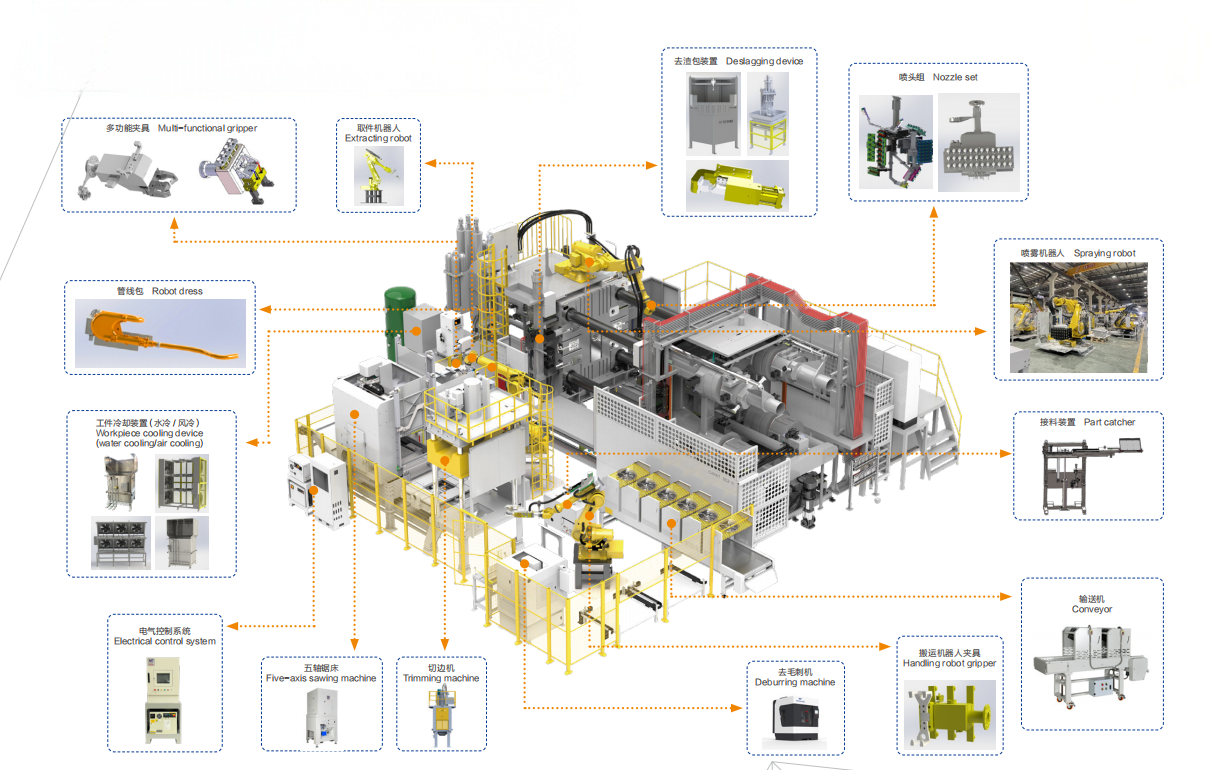
The rotor is the rotating heart of an induction motor. In most squirrel cage designs, the conductive cage is not assembled from separate bars. It is formed in one shot by high-pressure aluminum die casting directly inside the laminated rotor core, creating the bars, end rings, and often the cooling fan blades in a single cycle.
That simplicity is deceptive. Rotor die casting is one of the most quality-sensitive steps in motor manufacturing, because the defects it creates are hidden inside the core and directly reduce motor efficiency. This article explains how the process works, which defects matter, and what a modern rotor die casting island does to control them.
How rotor die casting works
A production cycle follows a repeatable sequence:
1. Core preparation. Rotor laminations are stacked with a skewed slot angle and pressed into a cartridge or directly into the die. The skew reduces cogging torque and noise in the finished motor. 2. Preheating. The core stack is preheated, typically to 300 to 450 C, so the molten aluminum does not freeze prematurely in thin slots. 3. Injection. Molten aluminum, held at roughly 660 to 720 C, is injected under high pressure. It fills every slot, both end rings, and any cast fan blades or balance features in one to three seconds. 4. Solidification and ejection. The die opens, the casting is ejected, and the cycle repeats. Modern cells run continuously with robots handling extraction. 5. Finishing. The runner system is trimmed, the shaft is pressed in, and the rotor is machined to final dimensions before balancing.
The defects that quietly kill efficiency
Because the cage is hidden inside the core, casting defects are invisible until testing. Four matter most:
1. Porosity. Trapped gas or shrinkage leaves voids in the bars and end rings. A porous bar carries less current, so the rotor develops less torque and runs hotter. 2. Broken or cracked bars. Uneven solidification or ejection stress can crack a bar completely. The motor still runs, but with higher slip, more vibration, and noticeably lower efficiency. 3. Cold shuts and misruns. If the metal starts to freeze before the cavity fills, the bar ends up partially formed, usually near the end rings. 4. Laminations shorted by aluminum. Excessive pressure can force aluminum between laminations, raising iron loss.
Each of these defects translates directly into motor losses. A rotor with casting voids can cost one to two percentage points of efficiency, which is often the difference between meeting an IE3 target and missing it.
The process window that prevents them
Stable rotor casting comes down to controlling four variables together: melt temperature and hydrogen content in the furnace, injection speed and pressure profile, die temperature, and venting or vacuum. Degassing and fluxing keep dissolved hydrogen low. A controlled slow-shot and fast-shot profile fills the slots without trapping air. Vacuum assistance is increasingly standard for EV and high-efficiency motor rotors, where porosity limits are tightest.
What a rotor die casting island includes
A modern rotor die casting island is a complete automated cell rather than a standalone press. A typical configuration combines a holding furnace with degassing and automatic dosing, the die casting machine, an extraction robot with spray and die monitoring, a trimming press, and inline inspection such as weight check, end ring vision inspection, or X-ray sampling, with every rotor traced by serial number. Automation here is not only about labor savings: it keeps the process window stable shift after shift, which is what actually protects efficiency.
Frequently asked questions
Q: Why is aluminum used for rotor die casting? A: Aluminum combines good conductivity, low density, and excellent castability. Copper cages conduct better but are far harder to cast, so copper is usually reserved for premium high-efficiency designs.
Q: Can casting defects be detected without cutting the rotor? A: Yes. Weight checks, electrical resistance testing of the cage, vision inspection of the end rings, and X-ray sampling all detect defects non-destructively. Inline resistance testing is the most common 100 percent check.
Q: What tonnage is needed for motor rotor casting? A: It depends on rotor diameter and projected area. Small appliance rotors run on compact machines, while large industrial rotors may need presses of several hundred tons of clamping force.
Q: How does skew affect the casting process? A: The skewed slots make filling slightly harder because the flow path spirals, which is why preheating and injection profile control are critical for skewed rotors.
Q: When should a rotor line be automated? A: When volume justifies continuous running, when porosity limits are tight, or when traceability is required by customers. For EV and premium efficiency motors, a fully automated die casting island is effectively the entry requirement.
Planning rotor production for a new motor program? We build turnkey rotor die casting islands covering melting and dosing, casting, extraction, trimming, inspection, and traceability. Share your rotor drawing and annual volume, and we will size the cell for you.
Product page: https://www.ldmotortech.com/en/products/die-casting